Live Product
SpecIQ — AI Documentation Platform
AI-powered spec sheet and compliance document generation for manufacturers and exporters worldwide.
- Industry
- Manufacturing & Export
- Engagement
- 8 months
- Shipped
- Mar 2025
- Role
- Nikshit Sehgal
In short
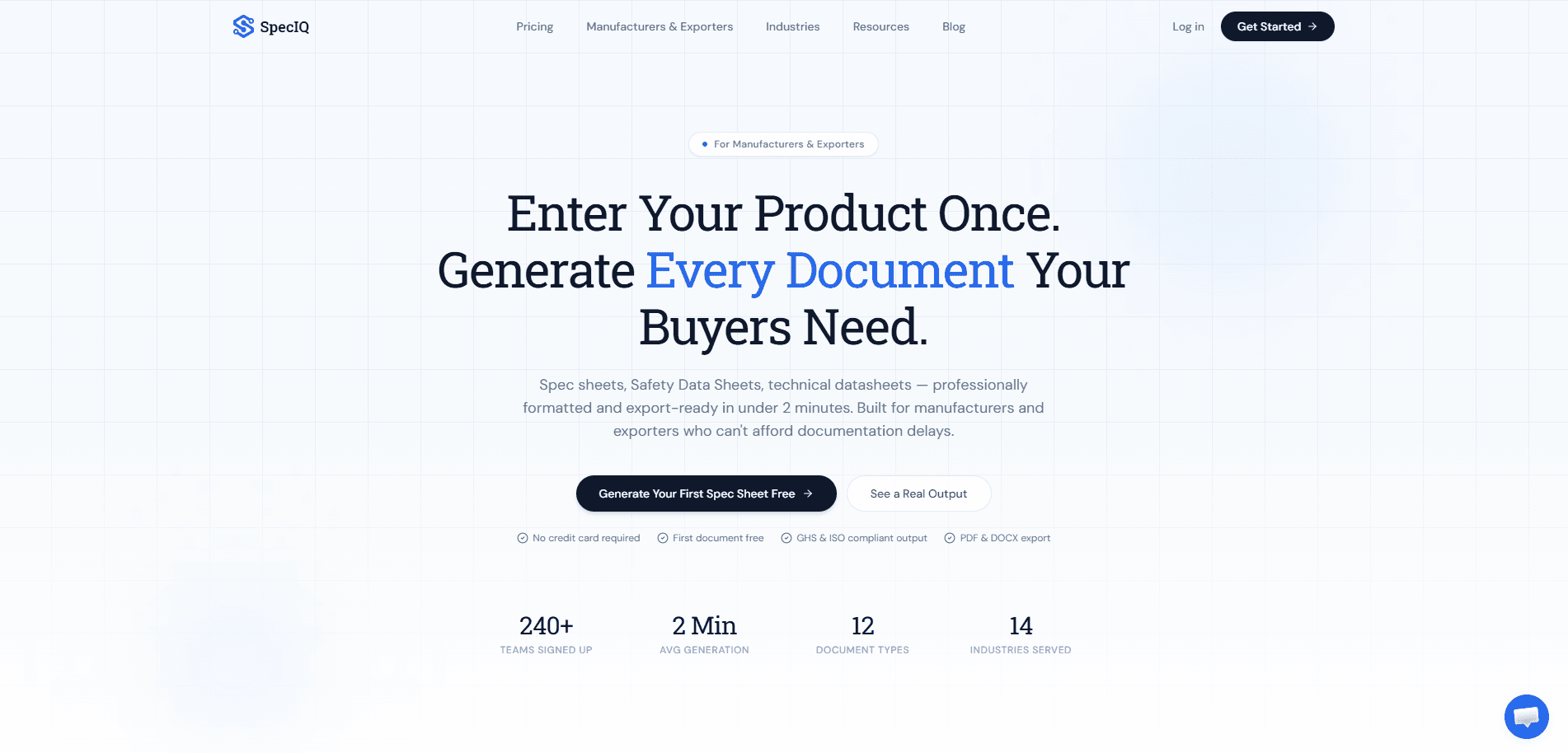
SpecIQ is a multi-tenant AI documentation platform for manufacturers and exporters worldwide. It generates 12 types of compliance documents (spec sheets, safety data sheets, certificates) in an average 47 seconds. Live at speciq.app with 500+ signups across 14 industries. Built end to end by Brioodev — product architecture, AI generation engine, multi-tenant workspaces, Stripe billing, admin tooling — over 8 months. Reference case study for the AI SaaS Development service.
The Problem
What was breaking.
Manufacturing and export businesses live on documentation. Every shipment needs spec sheets, safety data sheets, certificates of origin, material declarations, and a dozen other compliance artefacts — each one filled with the same product information typed manually into a different template. A growing exporter selling 80 products into 14 markets spends 4 to 6 hours per day rebuilding the same documents in slightly different formats.
The stakes are not small. One wrong field on a safety data sheet and a shipment gets rejected at the destination port. Versions get lost across email threads. Deals delay or fall through over documentation errors. The work is high-volume, high-stakes, and almost entirely repetitive — the exact shape of work AI is well-suited to handle, if the system is engineered correctly.
What Was Built
The delivered system.
SpecIQ replaces the manual documentation cycle end-to-end. The product is built on Next.js (App Router, TypeScript), with a Postgres-backed multi-tenant workspace model. Each tenant gets its own product catalogue (the 'Product Hub'), team roles with audit trails, and a versioning system for every generated document.
The core technical challenge was the AI generation system itself. Generic LLM output cannot meet international compliance standards — the document has to use the correct field names, the correct units, the correct cross-references, the correct regulatory citations. We built a structured generation pipeline: prompts are versioned in code, schema-validated against the target document type, evaluated against a golden set before every prompt change, and post-processed to enforce regulatory formatting. Average generation time landed at 47 seconds for documents that would otherwise take 30 to 90 minutes by hand.
Around the core engine: Stripe subscription billing with metered usage, an admin dashboard for support and feature flags, public document sharing with QR codes, and a Product Hub UI that exporters can train their teams on in a single onboarding session.
Outcomes
What changed because of this.
- Signups
- 500+
- Industries
- 14
- Document Types
- 12
- Avg Generation
- 47s
Tech & integrations
The tools this system runs on.
Named here for transparency — every choice was made for fit, not familiarity.
- Next.js
- React
- TypeScript
- Node.js
- PostgreSQL
- Prisma
- OpenAI API
- Stripe
- Tailwind CSS
- Vercel
- Resend
What made it hard
Lessons we'll carry forward.
Three things made this project meaningfully hard. First, getting AI output to clear an actual compliance checklist — not just 'look correct' — required building a separate evaluation harness that ran every prompt change against a golden set of documents. We treated the prompt as code, not as a configuration knob. Second, the multi-tenant data model was non-trivial because compliance documents reference products, suppliers, customers, and certifications across tenants in confusing ways; we ended up with a stricter workspace boundary than most early SaaS products use. Third, billing for an AI product with variable per-generation cost is genuinely different from billing for a flat-rate SaaS — Stripe metered usage with hard caps was the only sane answer.
Have something similar?
Let's scope what you're building.
Discovery call first, scope document second, build third. We take 1 to 2 new projects per month.